
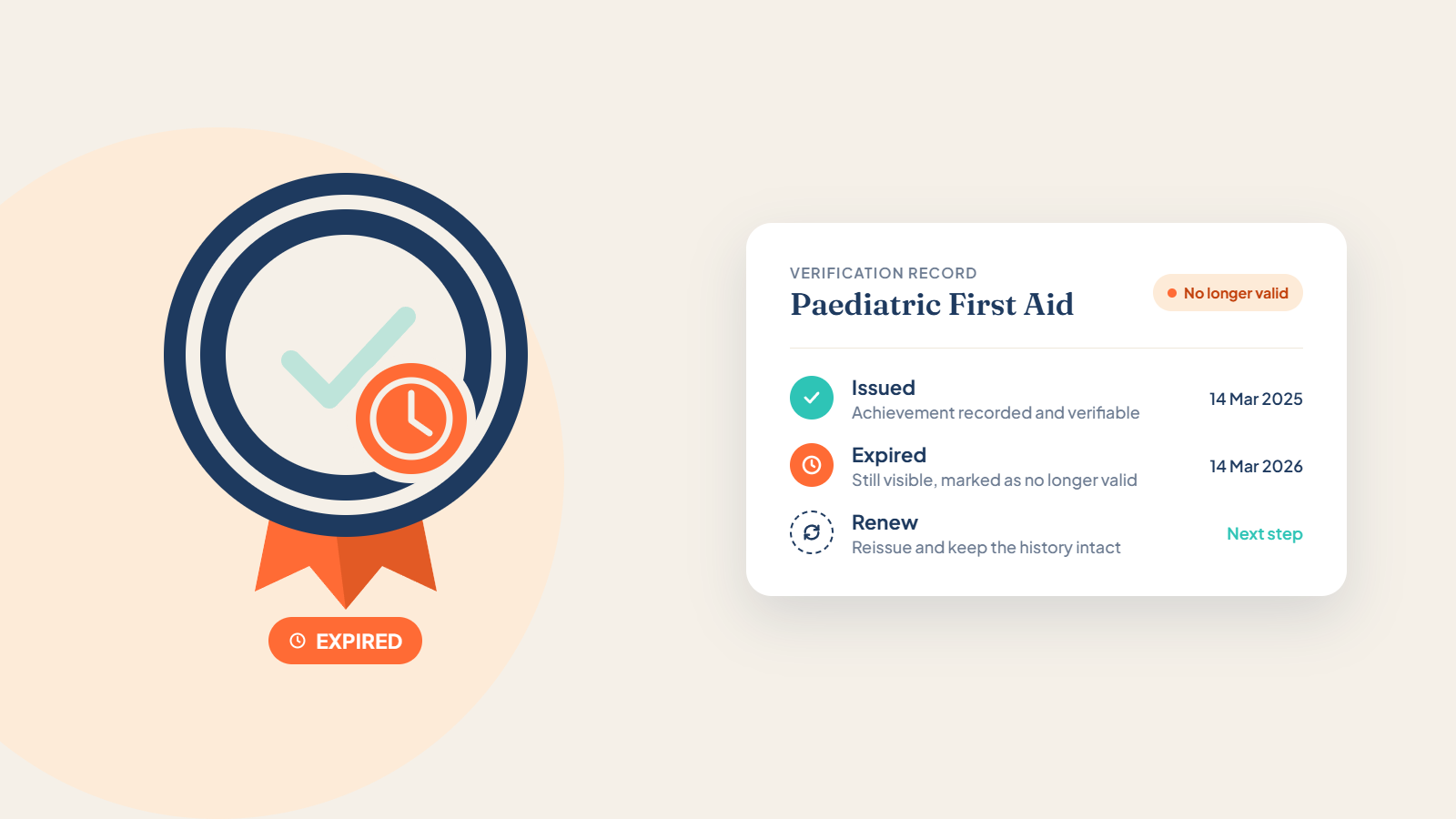
Someone on your team has just asked whether the badges you issue should have an expiry date, and what your learners will see if they do. The short answer: an expired digital badge does not disappear. It stays on the recipient's profile, but the verification page reports it as no longer valid, and that is the state an employer or auditor will see. Whether that is a problem or a feature depends entirely on what you decide before you issue.
This guide explains what expiry means in the Open Badges standards, what each party sees after the date passes, how expiry differs from revocation, and how to set up renewals so expiry works for you rather than against you.
Does a digital badge disappear when it expires?
No. An expired badge remains on the recipient's account and on any page where they have shared it. What changes is its verification status: from the expiry date onwards, a verifier checking the badge is told it should no longer be considered valid. The image and metadata are still there; the assurance behind them is not.
This is by design. The Open Badges 2.0 specification from 1EdTech defines an optional expires property on every badge assertion as "a timestamp when a badge should no longer be considered valid. After this time, the badge should be considered expired." The badge record itself is not deleted or altered; the verifier simply compares today's date with that timestamp.
The same idea carries into Open Badges 3.0, where the property is renamed validUntil and defined in the 1EdTech JSON schema as "a timestamp when a credential should no longer be considered valid". Open Badges 3.0 is built on the W3C Verifiable Credentials Data Model 2.0, a W3C Recommendation since 15 May 2025, which uses the same validFrom and validUntil pair to describe a credential's validity period. In other words, expiry is a first-class concept in the standards, not a platform quirk.
What does the recipient see when their badge expires?
The recipient keeps the badge, but it is labelled as expired wherever the issuing platform displays it, and any verification link they have shared will now report the badge as no longer valid. Most platforms do not remove it from the recipient's wallet or backpack, because a record of past achievement still has value.
For example, Credly's issuer documentation states that an expired badge "will remain on the earner's account indefinitely" with an expired marker shown next to it (Credly Help Center, "About expired badges", updated 24 August 2026). Behaviour varies by platform, so if you are comparing providers, ask to see the expired state of a real badge rather than relying on a feature list.
What recipients notice most is the moment of surprise: a badge they put on LinkedIn two years ago now shows as expired to a recruiter. That surprise is avoidable. If your badge has an expiry, say so in the badge description and in the issue email, and tell recipients how to renew before the date arrives.
What does an employer or verifier see?
A verifier opening the badge's verification page after the expiry date sees a clear statement that the badge has expired, alongside the original issue date, the issuer, and the criteria. The badge still proves that the achievement was earned on that date; it no longer proves that the holder is currently certified.
Under Open Badges 2.0, verification software is expected to check the expires timestamp and treat a badge past that date as no longer valid. Under Open Badges 3.0, verifiers check validUntil in the same way and can additionally check a credentialStatus entry, which the Open Badges 3.0 Implementation Guide recommends publishing as a Bitstring Status List so that revocations and suspensions can be looked up efficiently.
The practical consequence for issuers is that an expired badge is not embarrassing if the expiry is deliberate and explained. A safeguarding certificate that expires after three years is doing exactly what an employer expects it to do. An expired badge for a one-off award, where the expiry was set by accident, sends the wrong message.
How is expiry different from revocation?
Expiry is scheduled and time-based: the issuer sets the date at the time of issue, and the badge lapses on that date with no further action. Revocation is a deliberate act by the issuer, at any time, to withdraw a badge that should no longer stand, for example because it was issued in error or the holder breached a code of conduct.
The standards keep the two apart. Open Badges 2.0 has separate expires and revoked properties, with an optional revocationReason the issuer can publish. Open Badges 3.0 uses validUntil for expiry and credentialStatus for revocation and suspension. A verifier treats both as a failed check, but the message differs, and recipients feel the difference keenly: expiry is expected, revocation is a judgement.
For issuers, the rule of thumb is to use expiry for competence that genuinely decays or needs re-testing, and reserve revocation for exceptional cases. Using revocation as a substitute for a missing expiry date creates an audit trail that looks punitive.
Which badges should have an expiry date?
Set an expiry when the badge makes a claim about current competence that a reasonable employer would expect to be re-checked: first aid, manual handling, safeguarding, food hygiene, data protection training, most regulated CPD, and any qualification with a formal renewal cycle. Leave it open-ended when the badge records an achievement that is true forever, such as completing a course, winning an award, or attending an event.
A useful test is to ask what the expiry date would mean to the recipient's next employer. If "this person was certified three years ago" is materially different from "this person is certified now", the badge needs an expiry. If the two statements mean the same thing, an expiry only creates renewal admin and disappointed recipients.
Where the renewal period is set by a regulator, awarding body or professional body, use their interval rather than inventing one. Where it is your own decision, match the pace at which the underlying knowledge changes, and say the interval plainly in the badge criteria so nobody has to guess.
How do I set up renewals so expiry works in my favour?
Treat expiry as the start of a renewal journey, not the end of a relationship. Set the date at the template level so every badge in a programme behaves the same way, warn recipients before the date, and issue a fresh badge with a new expiry once the renewal criteria are met.
On Certify, expiry can be set at three points: on the credential template, on a specific issuance, or per recipient, as described in the Help Centre article on how to set expiry dates on credentials. Template-level expiry is the sensible default for a renewal-based programme, with the per-recipient option kept for genuine exceptions such as a mid-cycle transfer from another provider.
Three habits make the difference between an expiry programme that drives re-enrolment and one that generates support tickets. First, put the renewal route in the badge description itself, so the answer is visible wherever the badge is shared. Second, email recipients at least 60 days before expiry with a direct link to the renewal course or assessment. Third, when you reissue, keep the old badge on their record as expired rather than deleting it, because an unbroken history of renewals is itself evidence of sustained competence. If you want to see how recipients view their full history, the Recipient Backpack page shows what that looks like from their side.
Expiry, handled this way, is one of the strongest arguments for verifiable digital credentials over PDF certificates: a paper certificate never tells anyone it is out of date, whereas a badge does, automatically, to everyone who checks.
Frequently asked questions
Do all digital badges expire? No. Expiry is optional in both Open Badges 2.0 and 3.0. A badge only expires if the issuer set an expiry date when it was issued. Badges for one-off achievements usually have no expiry; badges for time-limited competence, such as first aid or safeguarding, usually do.
Can an expired badge be renewed? Not in place. The standards have no renew action, so an issuer renews by issuing a new badge with a new expiry date after the recipient has met the renewal criteria. The old badge stays on record as expired.
Is an expired badge the same as a revoked badge? No. Expiry is time-based and planned when the badge is issued. Revocation is a deliberate issuer action, taken at any time, usually because the badge was issued in error or the holder no longer meets the criteria. Both fail verification, but for different reasons.
Will an expired badge still show on LinkedIn? Yes, unless the recipient removes it. LinkedIn stores the badge as a certification entry the recipient added. Anyone who clicks through to the verification page will see that the badge has expired. See our guide on adding a digital credential to LinkedIn for how that entry is created.
Plan the expiry before you issue
The badges that cause problems are the ones where nobody decided. If you are setting up a programme with a renewal cycle, book a demo and we will walk through template-level expiry, renewal reminders and reissuing in fifteen minutes, or start free and set an expiry on your first template today.